Many small business owners think online marketing is too expensive or too complicated. Yet small businesses are exactly the ones that can get the most out of it: they reach precisely the people they need and only pay as much for ads as they decide to.
In this article, you’ll find the main benefits of online marketing, the three pillars it rests on, which channels to choose and a simple plan to get started.
The main benefits of online marketing for small businesses
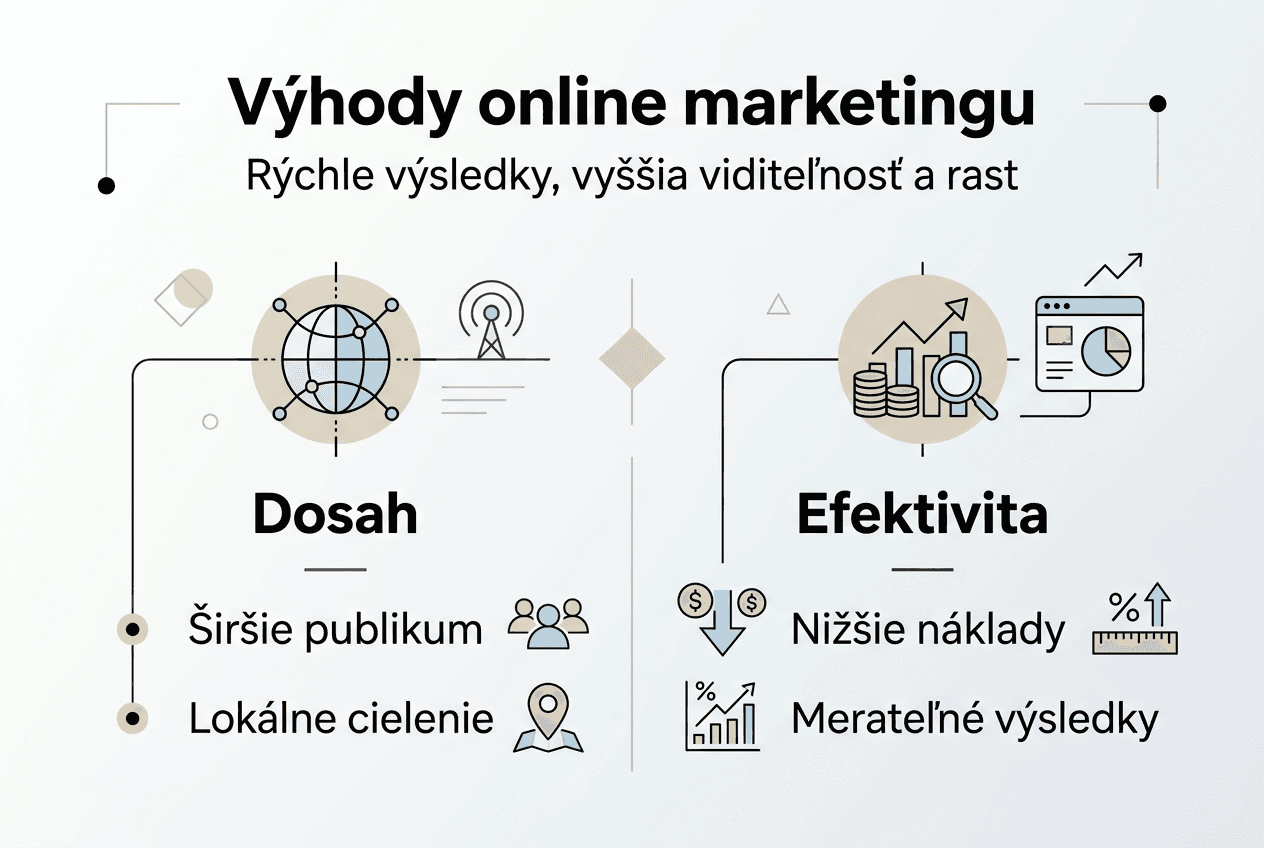
Precise targeting
A flyer in the mailbox reaches everyone, including people who aren’t interested in the offer. You can show online ads only to people in a specific town, with a specific interest or who are searching for your service right now. A hair salon in Bardejov doesn’t have to pay for people in Bratislava.
Measurability
You see how many people saw your ad, how many clicked and how many of them bought something. So you can tell which channel makes money and which one just spends it. With a billboard, you’ll never know that precisely.
A flexible budget
You can start with a smaller amount. You can raise or lower your budget or pause a campaign at any time – for example, when you’re fully booked or on vacation.
Speed
Ads on Google or social media can be running the same day. You can test a new offer in a few days, not a few months.
Direct contact with customers
Comments, messages, reviews and emails give you direct feedback. You find out what bothers people and can respond quickly.
Value that lasts
A well-written article, a quality website, search rankings you’ve built and your own email list keep working for you even when you’re not paying for ads.
The ability to test
Two versions of an ad, two headlines, two offers. Online, you can check what works with little risk and no big investment.
Online vs. traditional marketing: what’s the difference
- Targeting: a flyer or radio reaches everyone in range, online ads only selected people.
- Measurement: with a billboard, you guess; online, you see clicks, inquiries and revenue.
- Changes: you can’t fix a printed flyer, but you can change an online ad in a few minutes.
- Upfront costs: a traditional campaign often requires a bigger one-off investment, while online you can start gradually.
That doesn’t make traditional marketing pointless. A regional flyer or sponsoring a local event can complement online campaigns nicely – especially when they include a link or QR code that lets you measure their impact, at least partially.
Three pillars: content, distribution and measurement

Content answers the question of what you communicate and why. Website copy, articles, videos, photos, case studies. Good content solves customers’ problems and shows that you know your field.
Distribution determines where and to whom you deliver your content – in search, on social media, by email or in ads. Even the best article won’t be seen by anyone if you don’t send it anywhere.
Measurement tells you what works. Traffic, conversions, cost per customer, revenue. Without measurement, marketing is just guesswork. We write about which numbers to focus on in our article Key online marketing metrics.
How to connect the pillars in practice:
- Create a content plan with topics your customers care about.
- Choose two or three channels where your audience actually spends time.
- Set up tracking in Google Analytics 4 and your ad platforms.
- Test different formats and watch what brings results.
- Review the data once a month and adjust your plan.
The whole customer journey: See, Think, Do, Care
Customers rarely buy at the very first contact. The See–Think–Do–Care model splits their journey into four stages and suggests a different type of marketing for each:
- See – the person doesn’t know about you yet. Social media content, video and awareness ads help here.
- Think – they’re solving a problem and comparing options. How-to guides, comparisons, testimonials and SEO help here.
- Do – the customer is ready to buy. Search ads, remarketing and a clear offer on your website help here.
- Care – the person has already bought. Email marketing, post-purchase care and loyalty perks help here.
Remarketing means showing ads to people who have already visited your website – it reminds those who hesitate about your offer. Small businesses often invest only in the Do stage and then wonder why they’re running out of new prospects. Balanced marketing covers all four stages.
Which channels to choose
- Website – the foundation that all other channels lead to.
- Google Business Profile – a must for local businesses. It’s free, and it’s often the first thing customers see.
- Google Ads – catches people who are searching for your service or product right now.
- SEO – long-term search traffic without paying per click.
- Social media and Facebook and Instagram ads – building your brand and reaching people who aren’t searching yet.
- Email marketing – your own channel for repeat purchases and customer care.
When choosing, decide based on where your customers are, what content you can create regularly, how much time and budget you have, and whether you mainly need awareness, inquiries or direct sales.
What to watch out for
- Online marketing isn’t free. Even if you don’t pay for ads, you pay with your time.
- Doing everything at once doesn’t work. Five half-managed channels bring in less than two well-managed ones.
- Without tracking, you know nothing. Set up conversion tracking before you spend your first euro.
- Results take time. Ads bring visits quickly, while SEO and brand building are a longer game.
- Copying competitors. What works for a big online store won’t necessarily work for a local service. Decide based on your own data.
Example: a café in a small town
Picture a café that has so far relied only on passers-by. It starts with a complete Google Business Profile with photos and up-to-date hours. On Instagram, it regularly shows menu news and what goes on behind the scenes. Before the weekend, it runs a small ad for people within a few kilometers of the café, and invites guests to sign up for its newsletter when they pay. Once a month, it sends them an email with an invitation to an event.
After three months, its stats show how many people looked up directions, how many reservations came from the website and which posts worked. It then shifts the budget to where things work best. None of these steps is expensive or complicated – the results come from the fact that they build on each other.
A practical plan for the first three months
- Month 1: Check your website and Google Business Profile, set up tracking and pick one main goal.
- Month 2: Launch one paid channel, usually search ads, and post regularly on one social network.
- Month 3: Review the results, double down on what works and add email marketing for existing customers.
Frequently asked questions
How much money do I need to start?
It depends on the industry, the competition and your goals. You can start with a smaller budget if you focus it on one channel. Our recommended budget calculator will help you estimate a rough amount for advertising.
How quickly will I see results?
Paid ads bring traffic right away, but finding out what really works usually takes a few weeks. SEO and content need months, but then they bring steady traffic.
Which channel is best for my business?
The one where your customers are and where you can stay consistent. A local service often starts with a Google Business Profile and search ads, an online store with product ads, a B2B company with LinkedIn and email.
Should I do marketing in-house or with an agency?
It depends on the time and experience you have available in your company. A combination often works – the company handles content and communication, while the agency handles strategy, ads and tracking. You’ll find a comparison in our article Hire a “jack of all trades” or an agency?
How to get started with Tronos
Online marketing works best when your website, ads, SEO and emails all pull in the same direction. At Tronos, you get all of it in one place, with a monthly report that makes it clear what works. If you want to find out where your business has the most room to grow, get in touch – let’s do it together.