
Many business owners see marketing as a vague expense: some money goes to ads, some to posts, and nobody knows exactly what came of it. The problem usually isn’t marketing itself but the lack of a plan. A well-designed marketing strategy helps you spend money where it brings in customers and stop where it doesn’t. In this article, you’ll learn how to create one step by step, even if you don’t have a marketing department.
What a marketing strategy is
A marketing strategy is a long-term plan that says who you want to reach, with what offer, through which channels, for how much and how you’ll know whether it’s working. It isn’t a list of random activities but a system built on understanding the market, a clear point of difference and sensible use of resources.
The difference between strategy and tactics matters. Strategy is the direction — for example, “we want to become the first choice for bathroom remodeling in our district.” Tactics are the concrete steps to get there — a Google Ads campaign, photos of finished projects on Instagram, collecting reviews.
Why a small business needs a strategy too
A small business has a limited budget and limited time, and that’s exactly why it can’t afford to shoot in the dark. A strategy gives you:
- Less waste — you know what to invest in and what to skip.
- Measurable results — for every activity, you know what you expect from it and how you’ll measure it.
- Consistent communication — customers recognize you on your website, on social media and in email.
- Easier decisions — when a new “great opportunity” comes along, you can judge whether it fits the plan.
The building blocks of a strategy
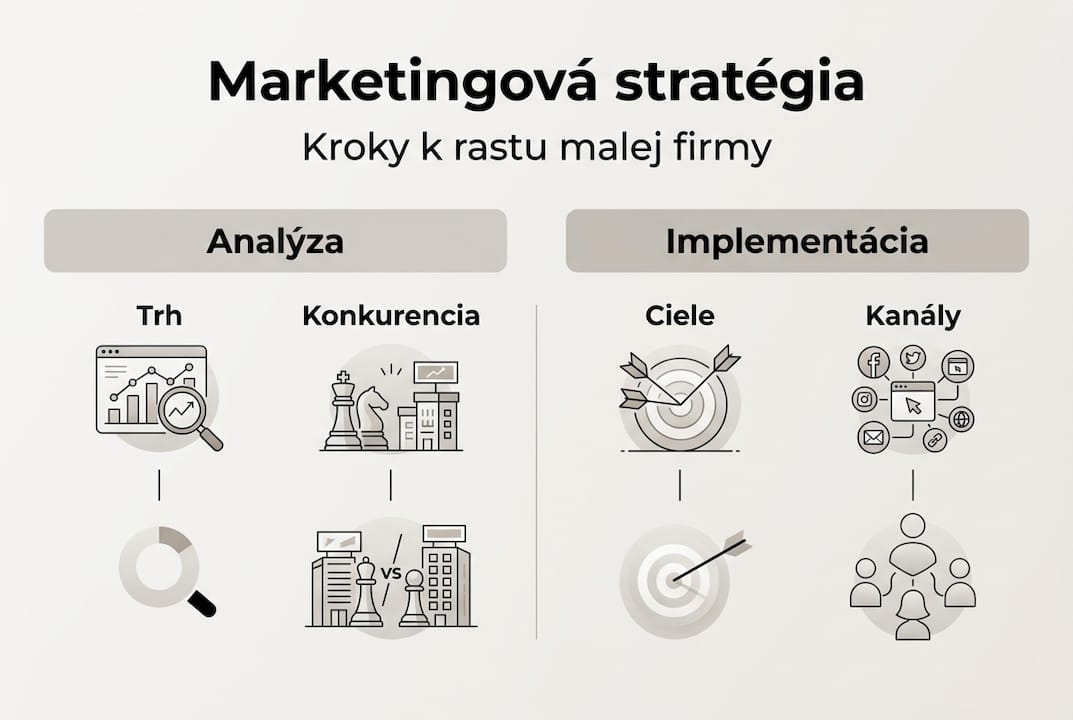
Market, competitor and customer analysis
Start with where you stand. Who are your customers, and what problems are they solving? Who are your competitors, how do they communicate, and where are they weak? What opportunities and threats do you see in the market? To start, a few conversations with customers and an hour spent on competitors’ websites and social media are enough.
SMART goals
“We want more customers” isn’t a goal — it’s a wish. SMART goals are:
- Specific — precisely defined in terms of what you want to achieve.
- Measurable — you can track progress in numbers.
- Achievable — realistic given your resources.
- Relevant — they support the company’s overall direction.
- Time-bound — they have a clear deadline.
Example: “By the end of the quarter, we want to get 50% more inquiries for air conditioning installation in the Prešov Region through our website than in the previous quarter.”
Point of difference
Why should a customer choose you? Speed, specialization, a personal approach, a guarantee, location? This point of difference will be at the core of all your communication. If you can’t name it, customers will decide based on price.
The 4P marketing mix
The marketing mix is the backbone of your strategy, made up of four parts:
- Product — what you offer and what value it brings the customer.
- Price — how your offer is priced compared with competitors and how much customers are willing to pay.
- Place — where and how customers buy: online store, physical location, sales rep, partners.
- Promotion — the channels you use to reach your target audience.
How to choose marketing channels
Each channel plays a different role in your strategy. Don’t think of them as competitors but as a team:
- Website — the foundation the other channels lead to. It has to say clearly what you offer and make it easy to get in touch.
- SEO — long-term traffic from people actively searching for you.
- Google Ads — quickly capturing existing demand.
- Social media — building awareness, trust and community.
- Email marketing — relationships with the customers you already have, and repeat purchases.
- Google Business Profile — for local businesses, often the first contact with a customer.
Choose channels based on where your customers are and at what stage of the decision you want to reach them. To start, it’s better to do two or three things properly than ten things halfway.
How much to invest and how to split the budget
There’s no universal percentage. Your budget depends on your industry, competition, company stage and goals. A few principles will help:
- A new company needs to invest more in awareness — so people know it exists at all.
- An established company can work more with existing customers, referrals and repeat purchases.
- Don’t put everything into one channel. Start with smaller amounts, test and gradually strengthen what works.

If you’re not sure how much to put into online advertising, our recommended budget calculator will give you a first estimate.
Step-by-step implementation
- Analyze the market, your competitors and your customers.
- Set SMART goals with specific numbers and deadlines.
- Name your point of difference and adapt your marketing mix to it.
- Choose channels based on customer behavior and your own resources.
- Launch activities gradually, test different approaches and collect data.
- Evaluate results regularly and adjust your plan.
- Strengthen what works and drop what doesn’t.
Don’t copy a competitor’s strategy without understanding the context. What works for another company may not work for you. Build on your strengths and on what you know about your customers.
Example: a local bakery
Imagine a small bakery in the center of a district town that’s losing customers because some people buy their bread at the supermarket. What could its strategy look like?
- Goal: more regular customers from the area and more orders for celebrations and corporate events.
- Point of difference: fresh baked goods made in-house, traditional recipes, a personal approach.
- Channels: a Google Business Profile with photos and responses to reviews, Instagram showing what goes on behind the scenes of baking, a simple cake-ordering page and local keywords on the website.
- Partnerships: taking part in local events and partnering with nearby cafés.
- Measurement: the number of orders via the website and phone, the number of reviews, searches for the bakery’s name.
A strategy like this doesn’t cost much money, but it requires consistency and patience. The first months usually bring only small improvements, but the effect adds up over time. We explain how to make a local business more visible in search in our article on local SEO.
How to measure and adjust your strategy
Set a few key indicators and track them at least once a month:
- website traffic and its sources,
- the number of inquiries or orders and the conversion rate,
- customer acquisition cost,
- customer lifetime value — how much a customer brings you over the entire relationship.
When something doesn’t work, don’t be afraid to change it. The ability to learn from data separates companies that grow from those that stagnate. You’ll find out which numbers matter and which just look nice in our article on key metrics in online marketing.
The most common mistakes
- Marketing without a goal — “we need to be on social media,” but nobody knows why.
- Trying to reach everyone instead of a specific target audience.
- Too many channels at once, and none done properly.
- No measurement — decisions based on gut feeling.
- Too much impatience — switching an activity off before it had a chance to deliver results.
Frequently asked questions
How much should a small business invest in marketing?
There’s no universal amount or percentage. It depends on your industry, competition, company stage and goals. Start with your strategy and goals, then set a budget and keep adjusting it based on results.
How do I choose the right marketing channels?
Find out where your target audience spends time and how they look for solutions. Combine long-term channels like SEO and content with faster ones like Google Ads or social media ads. Start with two or three and add more gradually.
Why is a marketing strategy important for business growth?
It makes sure all your activities head toward one goal and that you can measure their results. Without it, marketing tends to be chaotic and expensive, and it’s hard to say what brought in customers.
How long does it take to see results?
Paid campaigns can bring traffic almost immediately, but fine-tuning conversions takes weeks. Organic channels like SEO and content usually need several months. The best results come from combining short-term and long-term activities.
Can I handle the strategy myself, or do I need an agency?
You can handle a basic strategy yourself if you make time for analysis and regular evaluation. An agency brings experience from other projects and saves you time. A good compromise is to set up the strategy with an agency and handle part of the execution yourself.
Let’s do it together
A good strategy doesn’t have to be a thick book. A clear goal, a few well-chosen channels and regular measurement are enough. We help small and mid-sized businesses bring their website, advertising, SEO and social media together into one plan — so every euro counts.
If you want a strategy tailored to you, book a consultation with us.