Many business owners picture digital marketing as Facebook posts or Google ads. But those are just individual tools. Digital marketing is the whole system of how customers find you online, come to trust you, and buy, and how you measure all of it. In this article, you’ll learn what it includes and how to build a strategy from it, step by step, that helps your business grow.
What digital marketing is
Digital marketing is promoting your business, products, and services through online channels: search engines, social media, email, your website, video, or maps. It isn’t one tactic, but several channels working together and reinforcing each other.
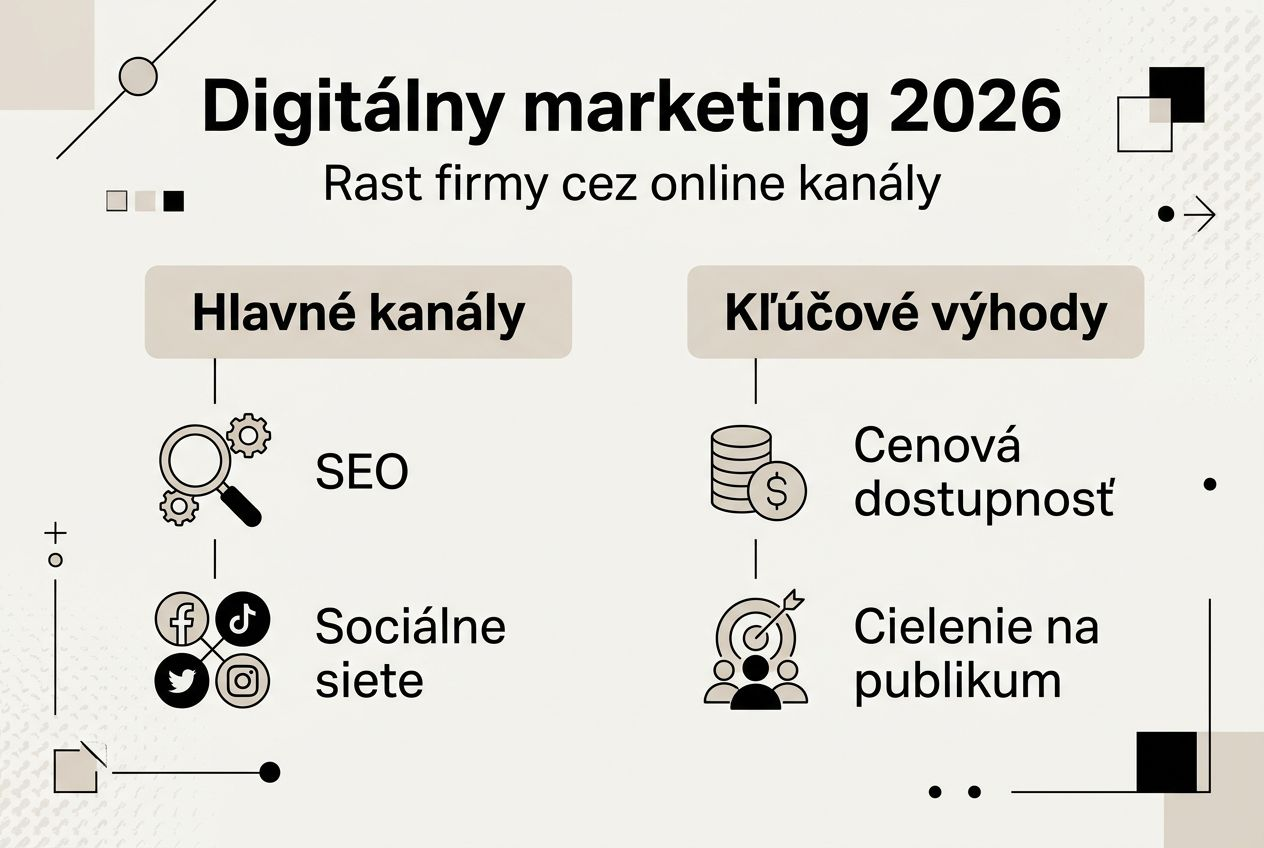
The main digital marketing channels:
- SEO: optimizing your website so people find you in search without you paying for clicks,
- PPC advertising: paid ads where you pay per click, for example on Google Ads or on Facebook and Instagram,
- social media: communicating with customers and building a community,
- email marketing: direct contact with customers and subscribers,
- content marketing: articles, guides, and videos that build trust and expertise,
- your website and Google Business Profile: the places where visitors decide whether to contact you.
If you come across a term you don’t understand, check out our Marketing ABC. In it, we explain marketing terms in plain language.
Why digital marketing matters for your business
- Customers search online. Even if they buy in a store, they often look you up first, read reviews, and compare offers.
- Everything can be measured. You see how many people saw your ad, clicked, and bought. With a flyer or a billboard, you can’t know that.
- Precise targeting. You reach people based on location, interests, or what they’re searching for right now.
- A flexible budget. You can start with small amounts and add more where the investment pays off.
- A small business can compete with big ones. A roofer from Bardejov can show up higher for “roof repair Bardejov” than a nationwide company.
We compare which type of online marketing suits which goal in Types of online marketing for small business growth.
How the channels work together: one customer’s journey
Customers rarely buy after the first contact. A typical journey can look like this:
- Lucia sees a video on Instagram of a local carpenter building a custom kitchen.
- A few weeks later, when she starts planning a renovation, she searches Google for “custom kitchens” plus her town. She finds the carpenter in the results and in Maps, with good reviews.
- On the website, she looks at past projects and downloads the price list in exchange for her email.
- Over time, she gets two emails with tips on choosing materials and an invitation to a free on-site consultation.
- Lucia books the consultation.
No single channel could have done this alone. That’s exactly why digital marketing pays off when you plan it as a whole, not as a series of separate campaigns.
Step 1: Set your goals with the SMART method
Without a goal, every campaign is a shot in the dark. The SMART method helps you phrase a goal so you can evaluate it:
- Specific: not “more customers,” but “more inquiries for air conditioning installation in the Prešov Region.”
- Measurable: you can express it as a number, such as the number of inquiries or orders.
- Achievable: it matches your resources, budget, and capacity.
- Relevant: it supports your business goal. Likes are nice, but if you want revenue, measure orders.
- Time-bound: it has a deadline, such as the end of the quarter.
An example of such a goal: “By the end of the quarter, we want to get more inquiries for air conditioning installation from our website than in the same period last year, measured in Google Analytics 4.”
A clear goal also helps with your budget. You know which channels contribute to it, and you can put the others on hold. We cover planning in more detail in Preparing an online marketing strategy.
Step 2: Get to know your audience
The best campaign fails if it reaches the wrong people. You need to know not only who your customers are, but also why they buy and where they spend time online.
- Demographics: age, location, occupation; for businesses, industry and size.
- Motivations and problems: what bothers them, what they want to achieve, what they worry about.
- Behavior: where they look for information, how long they take to decide, who makes the purchase decision.
A practical tool is a persona, a model customer with a name, a situation, and needs. Three examples:
- Maria, café owner: wants more local guests and reservations. Local SEO, Google Business Profile, and Instagram with food photos will reach her.
- Peter, IT manager at a manufacturing company: is looking for a reliable supplier. Case studies, expert articles, and LinkedIn will catch his interest.
- Jana, online store owner: wants to improve sales and cut ad costs. Remarketing, automated emails, and better product pages will help her.
Don’t keep your personas only in your head. Check them against data from Google Analytics 4, social media insights, and above all, conversations with customers.
Step 3: Create content and take care of the website experience
Content is everything people read, watch, and share from you. It works when it answers their questions and helps them make a decision.

Types of content that work well:
- short videos and product demos,
- guides and answers to frequently asked questions,
- case studies and testimonials,
- customer photos and reviews,
- calculators and simple tools.
Just as important is the website experience, known as UX (user experience). Even the best content won’t help if the page takes ages to load or can’t be read on mobile. Pay special attention to:
- loading speed, which you can check in Google PageSpeed Insights,
- readability and usability on mobile,
- a simple path to the product or service,
- clear headings and prominent call-to-action buttons,
- images that are resized and saved in modern formats, such as WebP.
Step 4: Measure results and adjust your strategy
Digital marketing doesn’t work on a “set it and forget it” basis. If you track the numbers regularly, you can move money to where it earns.
Key metrics:
- conversion rate for each channel,
- customer acquisition cost,
- website traffic by source,
- reactions and messages from social media,
- email opens and click-throughs,
- return on investment for individual campaigns.
We discuss which numbers matter and which just look nice in Key metrics in online marketing.
Free tools are all you need for tracking: Google Analytics 4 for your website, Google Search Console for search, plus the analytics in your social media and ad platforms. When reading the data, look for causes. If an ad gets lots of clicks but few orders, the problem is more likely on your website than in the ad.
A proven routine: a quick look at the main numbers once a week, and a deeper analysis and strategy adjustment once a month. Write down what you changed so you know what drove the result.
How to start on a small budget
- Fix your website and Google Business Profile. They’re the foundation for every other channel.
- Set up conversion tracking.
- Choose one or two channels based on where your customers are.
- Set a goal for the quarter and review it regularly.
- Only add another channel once the first one works.
Frequently asked questions
What does digital marketing include besides advertising?
SEO, content marketing, social media, email, website upkeep and reviews, Google Business Profile, and analytics. Paid advertising is just one part of it.
How long before I see results?
It depends on the channel. Paid ads bring traffic right away, but fine-tuning campaigns takes weeks. SEO and building a community on social media take months.
What’s the difference between SEO and PPC?
With SEO, you work on getting Google to show you in the results without paying for clicks. Results come more slowly, but they last. With PPC, you pay for every click; results are immediate, but they stop when you stop paying. They work best together.
Can a small business handle digital marketing on its own?
The basics, yes: your website, business profile, social media, and simple emails. For advertising, tracking, and technical SEO, it pays to work with someone who does it every day.
If you want digital marketing with a clear goal and measurable results, get in touch. We’ll look at your business, suggest the channels that make sense, and help you launch them.